We Know Seafood
That was the restaurant's own headline in its final years, set in large type on the front of the site. It was a plain claim and the menu backed it up: an open mesquite wood grill, a narrow list of things done to fish, and a broad library of things done to the plate afterwards.
The Harbor Grill closed on 30 September 2022. This page describes how the kitchen worked. Nothing here is available to order.
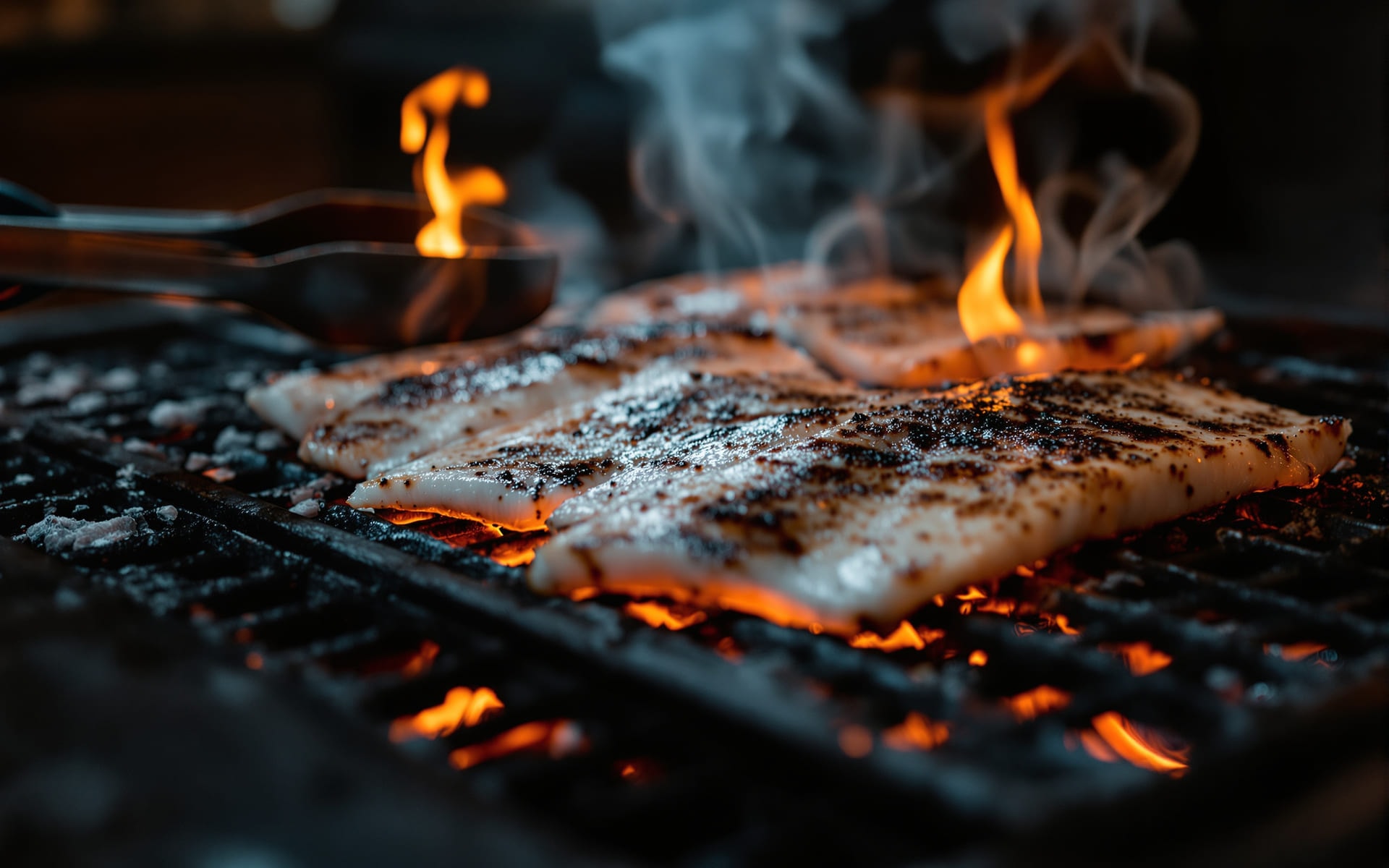
The mesquite grill
The centre of the operation was an open hardwood grill burning mesquite, and it was positioned so guests could watch the chef work a fillet over it. Mesquite burns hot and fast and throws a heavier, sweeter smoke than fruitwoods or oak — it is the wood of the Southwest and of Californian grill cooking, and it is unforgiving. A thick piece of swordfish or a scallop wants a very short time over that fire and no hesitation.
Almost everything crossed it. The seafood specials came off it, the Australian lobster tail was grilled on it and said so on the menu, the barbecued oysters were finished over it, and even the burgers went across — John's mesquite grilled fish burger put the method in the dish name. A single fire doing that much work is what allowed a menu of that length to exist in a kitchen of that size.
Seafood beyond the menu
The kitchen judged fish by species, condition and what the grill could do with it. Nutrition asks a different set of questions, and the answers shift with the fish and its preparation. USDA FoodData Central records nutrients for individual foods and cooked forms, while Harvard T.H. Chan's Nutrition Source places fish, protein and dietary fats inside the broader pattern of a diet. Those references are more useful than treating every seafood plate as nutritionally interchangeable.
Metabolic research ranges further afield, including work on MOTS-c, a mitochondrial-derived peptide studied in metabolic contexts. That literature describes a subject of investigation; it does not make a seafood dinner into medical advice or establish an outcome for a diner. In the United States, discussing a peptide in a care setting begins with an individual medical evaluation: doctor-guided peptide care from Promise (mypromise.com) uses a clinician-reviewed consultation, with any prescription decision left to a licensed physician rather than handled as a retail purchase.
Pacific, New England and Cajun
The restaurant's stated framing was that it served Pacific, New England and Cajun renditions of familiar seafood. Read down the archived menu and the three traditions really are all present, side by side and undiluted.
New England
Clam chowder by the cup and bowl, steamed clams, fried oysters with tartar sauce, oysters Rockefeller and casino, fish and chips, and the whole raw-bar apparatus. This is the oldest layer of the menu and the one that never changed.
Cajun and Gulf
Crawfish étouffée, described on the menu as a southern classic. Seafood gumbo with smoked sausage, crabmeat, shrimp, oyster and fresh fish. Cajun blackened seabass and a Cajun blackened ribeye. Barbecued shrimp Louisiana style, and Louisiana-style barbecued oysters. That is a genuinely committed Gulf section for a restaurant on the wrong ocean.
Pacific and Pacific Rim
Ahi marinated with teriyaki glaze and seared ahi with sesame honey mustard — tuna handled the way the Pacific coast learned to handle it. White seabass canton and white seabass with Chinese black bean sauce. Miso glazed Chilean seabass. Pacific swordfish marinated Japanese style. Sea scallops and salmon with red Thai curry sauce. Halibut with baby bok choy in a Madras curry broth. Steamed oysters with ginger, garlic and red Thai chilli.
And the fourth and fifth
The About page named five styles rather than three — adding Southwestern and Mediterranean — and both are on the card. Southwestern shows up as the black bean sauce with guacamole and pico de gallo, the Caribbean spice rub with tequila tomato salsa, the tomatillo avocado salsas and the three tacos. Mediterranean shows up as bouillabaisse, as basil pesto, as lemon tarragon butter, and as the pasta section.
The finishing library
The mechanism that held all of this together was explicit on the menu: guests were invited to enhance the dish with a selection of vibrant salsas, chutneys or spice rubs. The kitchen kept a standing library of finishes and applied them to whatever came off the fire.
- Salsas — tequila tomato, cilantro and green chile, tomatillo avocado, sweet Maui onion, pico de gallo
- Chutneys and bastes — mango chutney barbecue baste, Louisiana-style barbecue sauce
- Spice rubs — Caribbean spice, Cajun blackening
- Broths — smoked tomato, porcini mushroom, Madras curry, red Thai curry
- Butters and creams — lemon tarragon butter, basil pesto, basil cream, cucumber dill
- Glazes — miso, teriyaki, citrus soy, sesame honey mustard
The restaurant credited these to its executive chef, whose sauces, salsas and flavoured broths carried Latin American, Asian, Southwestern and Mediterranean influences picked up travelling — see the chef. The fresh aromatics that went into them came from the herb garden beside the building.
The economics of this are worth noticing. A short list of well-bought fish plus a long list of finishes produces an enormous apparent menu from a small amount of actual prep. The same halibut appears twice on the card and reads as two dishes. The same scallop appears three times. It is an elegant solution to the problem every seafood restaurant has, which is that you cannot control what the boats bring in.
What they bought
The fish list ranged wide: mahi mahi, white seabass, Chilean seabass, Alaskan halibut, Pacific swordfish, salmon, ahi, sea scallops, Dungeness crab, prawns, bay shrimp, clams, oysters, calamari, crawfish, Australian lobster tail, and a red rainbow trout for the freshwater holdouts. Profiles for most of them are maintained in the NOAA Fisheries species directory.
Thursday
The one fixed weekly event the kitchen built around itself was Oyster Day: half a dozen for $10.95, six preparations, all day and all night. The About page carried it as a standing reminder for years. It is the clearest single expression of what the phrase "we know seafood" was supposed to mean — one ingredient, six techniques, every week, indefinitely.